Read and manage the suppression list
Understand why an address is suppressed, which ones you may remove and which you may not, and why bulk-clearing the list is a bad idea.
The suppression list holds addresses the system will no longer send to. Your software still reports a successful send, but the message is dropped before leaving the system — nobody receives anything.
Before you start
- You can already send. See Send your first message through the relay
Why the list exists
Read the reason column
Go to Email Relay → Suppression list.
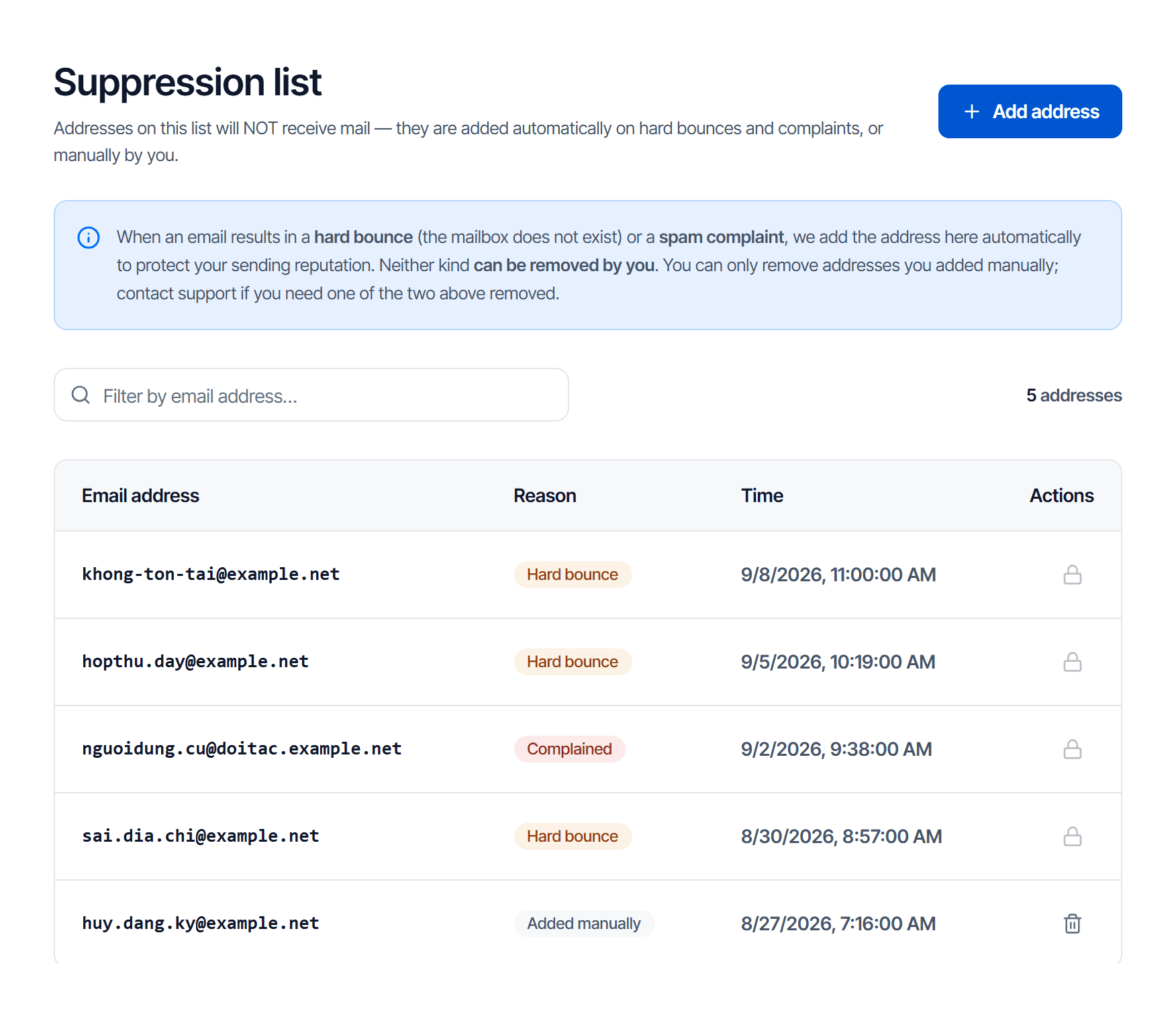
| Reason | Means | Can you remove it |
|---|---|---|
| Hard bounce | the receiver said this address does not exist — a definitive answer, not delayed or temporarily refused mail | no — contact support |
| Spam complaint | the recipient pressed the report-spam button | no — contact support |
| Added manually | you or a colleague added it. Re-adding a locked address does not lower its reason | yes |
The first two are locked deliberately. Sending reputation is shared across the whole platform: mailing a hard-bounced address again spoils the numbers for every customer, not just you.
When to add manually
Click Add to suppression list and enter the address. Two cases worth doing proactively:
- A customer asks to stop receiving mail — add them immediately, do not wait for them to report you
- You know an address has been retired, for example an employee who left
Removing an address
Remove from the suppression list appears only on Added manually rows; the other two show a lock icon. The confirmation says it plainly: that address can receive your mail again.
To get a locked row removed, ask support and include:
- The address, and the reason shown next to it
- Evidence that it works again: the owner confirms it, or you control the domain and know the mailbox was recreated
Never clear out your manual rows to tidy the list
Addresses you added yourself are usually people who asked to stop receiving mail. Remove them, send again, and you push them straight to the report-spam button — and a complaint is one nobody can undo for you.
With both Email API and Email Relay on, the list can be shared
Suppressed addresses are synchronised between the two services, and such rows carry a label saying which service they came from. That is deliberate: an address that does not exist does not exist for either sending path.
If you remove one on one side, check the other.
An empty list
"The suppression list is empty" is a good state. Hard-bounced and complained addresses appear here by themselves — you do not have to do anything to get them in.
If the list is empty and mail still does not arrive, the cause is elsewhere — see Troubleshoot Email Relay.
Check your work
After adding an address to the suppression list, send a test message to it:
- Your software still reports success — by design, not a fault
- No message arrives
- Stats & logs shows the message suppressed, not failed in transit
Point 1 is where confusion starts. Your software only knows the system accepted the message; it does not know what happened next. The logs are where the truth is.